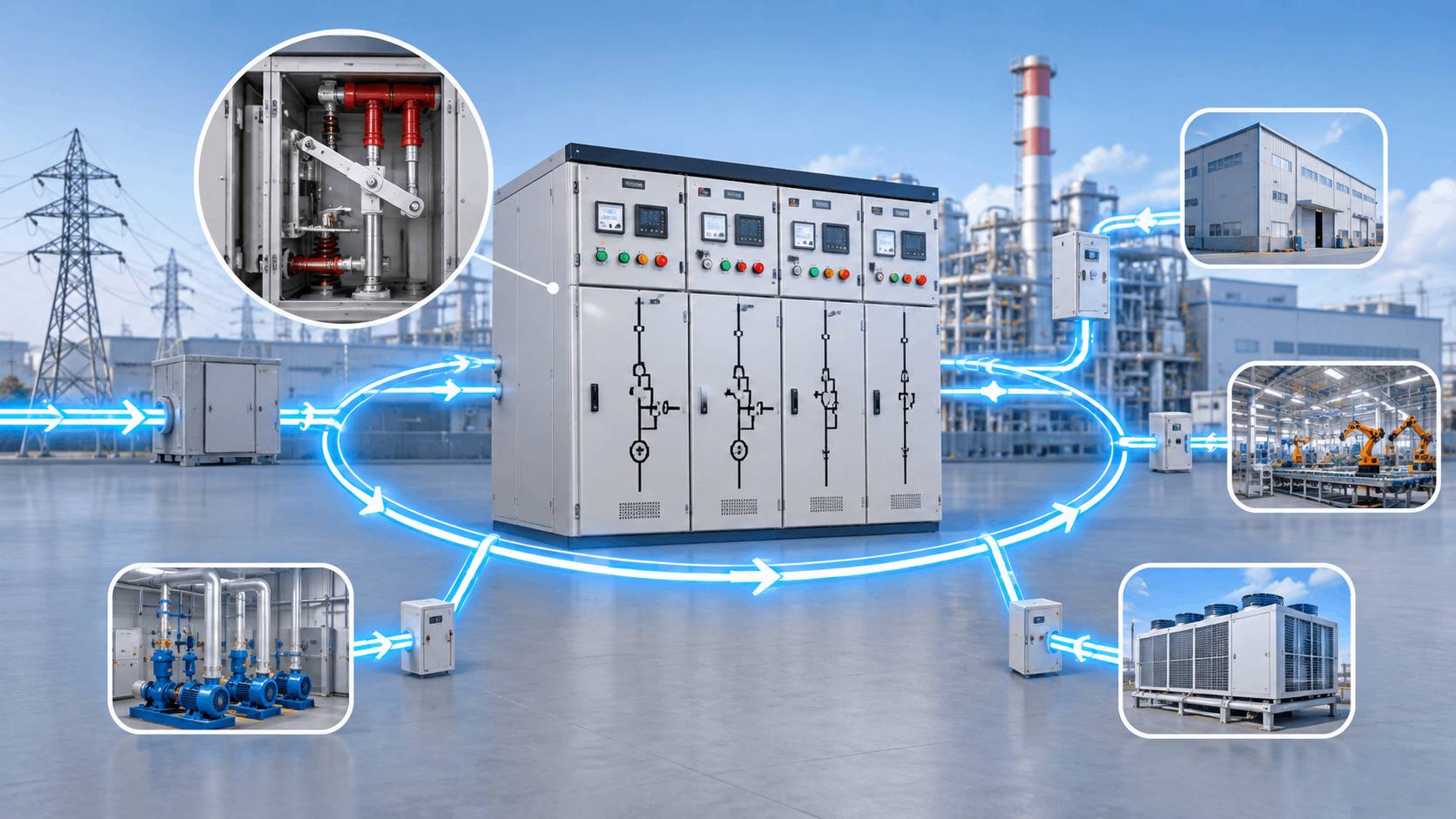
Ring main units (RMUs) are essential components of medium-voltage power distribution networks. They provide switching, isolation, and protection functions that help distribute electrical power safely across industrial facilities, commercial buildings, renewable energy installations, and urban distribution systems. Because RMUs often operate in networks where continuity of power supply is important, their reliability directly affects the stability and efficiency of the entire electrical system.
However, like other electrical distribution equipment, ring main units can develop faults over time. Electrical insulation deterioration, mechanical wear, loose connections, moisture ingress, incorrect operation, and inadequate maintenance may all affect equipment performance. If these problems are not identified early, they can lead to unexpected outages, equipment damage, and increased maintenance costs.
Understanding the common faults in ring main units and knowing how to prevent them can help facility managers, electrical engineers, and maintenance teams improve operational reliability. This article examines the typical RMU problems found in medium-voltage distribution systems, explains their possible causes, and outlines practical preventive measures.
1. Insulation Failure in Ring Main Units
Insulation failure is one of the most serious potential problems in medium-voltage switchgear, including ring main units. Electrical insulation separates energized components from grounded structures and other conductive parts. When insulation performance deteriorates, the risk of partial discharge, flashover, and short circuits increases.
Common Causes of Insulation Failure
Several factors can contribute to insulation deterioration:
-
Aging of insulation materials: Long-term electrical and thermal stress can gradually reduce the dielectric strength of insulating components.
-
Moisture and condensation: Water vapor inside an RMU enclosure may affect insulation performance, particularly in humid environments.
-
Dust and contamination: Conductive particles, chemical deposits, and other contaminants can accumulate on insulating surfaces.
-
Electrical overvoltage: Switching surges, lightning-related surges, and abnormal operating conditions may place additional stress on insulation systems.
-
Manufacturing or installation defects: Improper assembly, damaged components, or insufficient electrical clearances can create weak points.
In gas-insulated ring main units, the condition and sealing integrity of the insulation system are particularly important. In solid-insulated RMUs, the quality and condition of solid dielectric materials require appropriate inspection and monitoring.
How to Prevent Insulation Failure
Preventive measures should begin with correct equipment selection. The rated voltage, insulation level, operating environment, and applicable electrical standards must match the requirements of the installation.
Regular maintenance should include visual inspections for contamination, cracks, abnormal discoloration, and signs of overheating. Where appropriate, electrical testing and partial discharge monitoring can help identify developing insulation problems before they result in equipment failure.
For gas-insulated equipment, maintenance personnel should follow the manufacturer's procedures for checking gas pressure or density indicators, monitoring alarms, and identifying possible leakage. For solid-insulated equipment, inspection should focus on the condition of insulating surfaces, connections, and enclosure integrity.
It is also important to control moisture inside the switchgear enclosure. Suitable ventilation, anti-condensation heaters where specified, and proper sealing can help reduce the risk of condensation.
2. Mechanical Operating Mechanism Failure
The switching mechanism is responsible for opening and closing the relevant electrical circuits. It may operate load break switches, earthing switches, or circuit breakers, depending on the RMU configuration.
A mechanical fault can prevent the equipment from completing a switching operation correctly. In some cases, the switch may become difficult to operate. In more serious situations, the mechanism may fail to reach its intended position, affecting the safety and reliability of the distribution network.
Common Symptoms and Causes
Typical signs of mechanical problems include:
-
Switching handles becoming unusually difficult to operate.
-
Incomplete opening or closing operations.
-
Abnormal noise during switching.
-
Excessive vibration or inconsistent operating resistance.
-
Mechanical interlocks failing to engage or release correctly.
These problems may result from worn components, insufficient lubrication, corrosion, contamination, misalignment, or damage caused by improper operation.
Mechanical mechanisms can also deteriorate when equipment remains unused for extended periods or when switching operations exceed the manufacturer's recommended limits.
How to Prevent Mechanical Failures
Routine inspection is essential for maintaining the mechanical performance of ring main units. Maintenance personnel should check operating handles, linkages, springs, shafts, and other accessible mechanism components according to the manufacturer's instructions.
Lubrication should only be carried out using the specified products and procedures. Applying unsuitable lubricants or excessive lubricant may attract dust and interfere with mechanical movement.
Operators should also follow the correct switching sequence and avoid applying excessive force when operating the equipment. If a switching mechanism becomes unusually difficult to operate, personnel should stop and investigate the cause rather than attempting to force the mechanism into position.
For installations with infrequent switching operations, a maintenance schedule should include the inspections and functional checks recommended by the equipment manufacturer. All switching tests must be performed by qualified personnel under approved safety procedures.
3. Gas Leakage in Gas-Insulated Ring Main Units
Gas leakage is a potential fault associated with gas-insulated ring main units. In these designs, insulating gas is contained within a sealed enclosure to provide the required dielectric performance. If the enclosure or its sealing components become damaged, gas leakage may reduce the insulation capability of the equipment.
The consequences depend on the insulation technology, gas type, equipment design, and severity of the leakage.
Common Causes of Gas Leakage
Gas leakage may occur because of:
-
Deterioration or damage to sealing components.
-
Loose or improperly installed connections.
-
Corrosion or mechanical damage to the enclosure.
-
Manufacturing defects in welded or sealed sections.
-
External impact during transportation or installation.
-
Aging of sealing materials under temperature variations.
A decrease in gas density or pressure may trigger an alarm, depending on the RMU design and monitoring arrangement.
How to Prevent Gas Leakage
The most effective approach is to select equipment with a properly designed and tested sealed enclosure. Installation teams should handle gas-insulated ring main units carefully to avoid damaging the enclosure, bushings, valves, or sealing interfaces.
During routine inspections, maintenance personnel should check gas pressure or density indicators and investigate any abnormal readings or alarms. If the equipment includes a gas monitoring system, alarm records should be reviewed as part of the maintenance process.
Any suspected leakage must be handled according to the manufacturer's technical instructions and applicable environmental and electrical safety requirements. Repairs, gas recovery, and refilling should only be carried out by appropriately trained and authorized personnel.
It is also important to distinguish between gas-insulated and solid-insulated RMU maintenance requirements. Solid-insulated ring main units do not depend on an insulating gas enclosure in the same way, so gas leakage prevention is not applicable to those designs.
4. Overheating of Electrical Connections
Overheating is another common issue in medium-voltage distribution equipment. Electrical connections generate heat during normal operation because of their electrical resistance. If contact resistance increases or current exceeds the equipment's design limits, temperatures may rise beyond acceptable operating conditions.
Persistent overheating can accelerate insulation aging, damage contact surfaces, and reduce the service life of electrical components.
Why Do RMU Connections Overheat?
Several conditions may contribute to excessive temperature increases:
Loose electrical connections: Inadequately tightened connections can create higher contact resistance and localized heating.
Contact wear: Repeated switching operations and electrical stress may gradually affect the condition of switching contacts.
Overloading: Operating equipment beyond its rated current can increase thermal stress.
Corrosion and contamination: Oxidation or surface contamination may reduce electrical contact quality.
Poor installation practices: Incorrect assembly, unsuitable connection components, or improper torque application may affect the reliability of electrical joints.
How to Prevent Overheating
Correct installation is the first step in preventing overheating. Electrical connections should be assembled according to the manufacturer's specified procedures, including the required tightening torque and connection components.
During scheduled maintenance, qualified technicians should inspect accessible connection points for signs of discoloration, corrosion, or physical damage. Infrared thermography can also help identify abnormal temperature differences without requiring direct contact with energized components, provided it is performed under suitable safety procedures.
Load conditions should be monitored to ensure that the RMU operates within its rated current capacity. If overheating is detected, the cause must be investigated before the equipment returns to normal service.
5. Circuit Breaker and Switching Contact Problems
In RMUs equipped with circuit breakers, breaker-related faults can affect the equipment's ability to interrupt fault currents or perform normal switching operations.
Switching contacts may deteriorate over time due to electrical stress, mechanical wear, or operating conditions outside the equipment's specified limits.
Typical Contact and Circuit Breaker Faults
Common problems include:
-
Excessive contact resistance.
-
Contact erosion or damage.
-
Failure to open or close correctly.
-
Abnormal operating times.
-
Mechanism wear or spring deterioration.
-
Inconsistent electrical continuity.
A circuit breaker that does not operate correctly may compromise the protection of downstream equipment. Similarly, damaged switching contacts can increase resistance and create localized heating.
How to Prevent These Problems
Maintenance personnel should follow the manufacturer's inspection and testing schedule. Depending on the breaker design and service conditions, checks may include contact resistance measurement, mechanical operation testing, insulation testing, and verification of opening and closing performance.
The number of switching operations and the electrical duty experienced by the breaker should also be considered when planning maintenance. Equipment operating in networks with frequent switching or demanding fault conditions may require closer monitoring.
Replacement of worn contacts or mechanical components should use approved spare parts and procedures. Improvised repairs can affect the electrical and mechanical performance of the ring main unit.
6. Protection Relay and Control System Malfunctions
Modern ring main units may incorporate protection relays, current transformers, voltage transformers, communication interfaces, and remote monitoring systems. These components help detect abnormal electrical conditions and support coordinated protection and network operation.
If a protection or control system malfunctions, the RMU may fail to respond correctly to an abnormal condition or may produce unnecessary alarms and switching actions.
Common Causes of Control and Protection Problems
Potential causes include:
-
Incorrect protection relay settings.
-
Wiring errors or loose control connections.
-
Power supply interruptions.
-
Faulty sensors or instrument transformers.
-
Software or configuration problems.
-
Communication failures between the RMU and remote control systems.
Incorrect relay settings are particularly important because they may affect fault detection, selectivity, and coordination with other protective devices.
How to Prevent Control System Failures
Protection settings should be established through an engineering study that considers the electrical network, fault levels, transformer characteristics, and coordination requirements. Changes should be documented and approved by qualified personnel.
Routine testing should verify relay operation, control wiring, trip circuits, and relevant communication functions. Where remote monitoring is installed, maintenance teams should periodically review alarm records and communication status.
It is also important to maintain accurate electrical drawings, protection setting records, and control system documentation. These records help technicians identify configuration changes and diagnose problems more efficiently.
7. Moisture Ingress and Corrosion
Ring main units are often installed in substations, outdoor distribution areas, industrial facilities, and underground electrical rooms. These environments may expose equipment to humidity, rainwater, dust, chemicals, and temperature fluctuations.
If moisture enters the enclosure, it can contribute to corrosion, insulation deterioration, and control circuit problems.
Factors That Increase Moisture-Related Risks
Moisture ingress may be associated with:
-
Damaged enclosure seals or cable entry points.
-
Poor drainage around outdoor installations.
-
Condensation caused by temperature changes.
-
Inadequate enclosure protection for the installation environment.
-
Incorrect installation of cable glands and access covers.
Corrosion may develop on metallic surfaces, fasteners, grounding connections, and other components. In severe cases, it can weaken mechanical structures or affect electrical continuity.
How to Prevent Moisture and Corrosion
The enclosure protection rating should be appropriate for the installation location. Before purchasing an RMU, project engineers should consider exposure to rain, dust, humidity, chemical substances, and other environmental conditions.
Installation teams should ensure that cable entries, access covers, and enclosure seals are correctly fitted. Outdoor installations should also provide suitable foundations and drainage to reduce the risk of standing water.
During inspections, maintenance personnel should look for rust, damaged coatings, water marks, condensation, and deteriorated sealing materials. Any identified problem should be corrected using the manufacturer's approved maintenance procedures.
For installations in coastal or chemically aggressive environments, corrosion-resistant materials and suitable protective coatings may help improve long-term equipment durability.
Conclusion
Common faults in ring main units include insulation deterioration, mechanical mechanism failure, gas leakage in gas-insulated designs, overheating connections, switching contact problems, protection system malfunctions, moisture ingress, and interlocking failures. Although these issues can affect equipment reliability, many can be reduced through correct equipment selection, professional installation, regular inspection, condition monitoring, and proper operator training.
For electrical engineers, facility managers, and procurement teams, understanding these potential problems is essential when planning reliable medium-voltage power distribution systems. A well-designed preventive maintenance strategy, combined with equipment that matches the project's electrical and environmental requirements, can help minimize unexpected outages and support long-term operational performance.
When evaluating RMU solutions, buyers should also consider the manufacturer's engineering experience, production quality, testing procedures, and technical support capabilities. Vensol provides ring main unit and medium-voltage power distribution solutions for different project requirements. By selecting suitable equipment and following appropriate maintenance practices, project teams can build more dependable distribution networks and maintain stable electrical operation over the long term.
www.vensolws.com
vensolws
