Off-road drivers navigating narrow trails, rock gardens, and low-visibility desert or winter terrain face a recurring challenge: most auxiliary lighting is engineered to project forward, leaving the vehicle's flanks in shadow exactly where obstacles, drop-offs, and other trail hazards are most likely to appear. Improving peripheral illumination without sacrificing waterproofing, durability, or installation flexibility requires a different engineering approach than a standard forward-facing light bar. Shenzhen Aurora Technology Limited, operating under the brand Aurora, has built its product architecture around exactly this kind of demanding, multi-directional lighting requirement.
Why Standard Off-Road Lighting Often Falls Short
Two structural weaknesses commonly limit how auxiliary lights perform once they are mounted away from the primary forward beam path. First, traditional offroad light bars often suffer from weak waterproof performance because screws used to compress Lexan lenses create inconsistent pressure points. This is a meaningful concern for any light mounted along a vehicle's sides, roof rack edges, or rear bumper corners, where exposure to mud spray, water splash, and vibration is more direct than on a front-facing bar. Second, conventional LED lighting frequently runs into what is described as the "N+1" or "N+N" media conversion problem, where multiple heat transfer layers between the PCB and housing reduce both heat dissipation efficiency and optical focus — a problem that becomes more pronounced when a light must run continuously to maintain steady peripheral coverage.
Engineering Wide-Angle Coverage for the Vehicle's Flanks
Flood Beam Optics and Uniform Illumination
Rather than relying solely on concentrated spot beams, Aurora's product line incorporates flood-oriented optics designed for broader, more even coverage. The Evolve LED Light Bar integrates High beam, Low beam, Scene beam, Flood beam, and Spot beam functions in a single unit, supported by 6-level dimming and RGB backlighting, allowing an operator to select a flood or scene pattern suited to lighting the ground and terrain adjacent to the vehicle rather than only the path ahead. Similarly, within the S13/D13 potted light bar line, the 10-inch ALO-P-10-D13-R17Y-AW-02 model is built with a dedicated flood light cup, delivering a two-row LED layout in a compact housing that suits mounting positions such as roof racks or bumper corners where space is limited but wider-angle output is needed.
Underpinning this is Aurora's AR Reflector Technology, which is described as producing uniform illumination and eliminating dark spots for "smart" road lighting with reduced glare. For peripheral or side-area lighting, uniformity matters as much as raw output, since uneven hot spots and dark gaps can be more disorienting than simply dim light.
Modular Arrays for Extended Perimeter Lighting
A single fixed light bar cannot always match the length or configuration needed to light a vehicle's full flank. Aurora addresses this through modular and linkable product families:
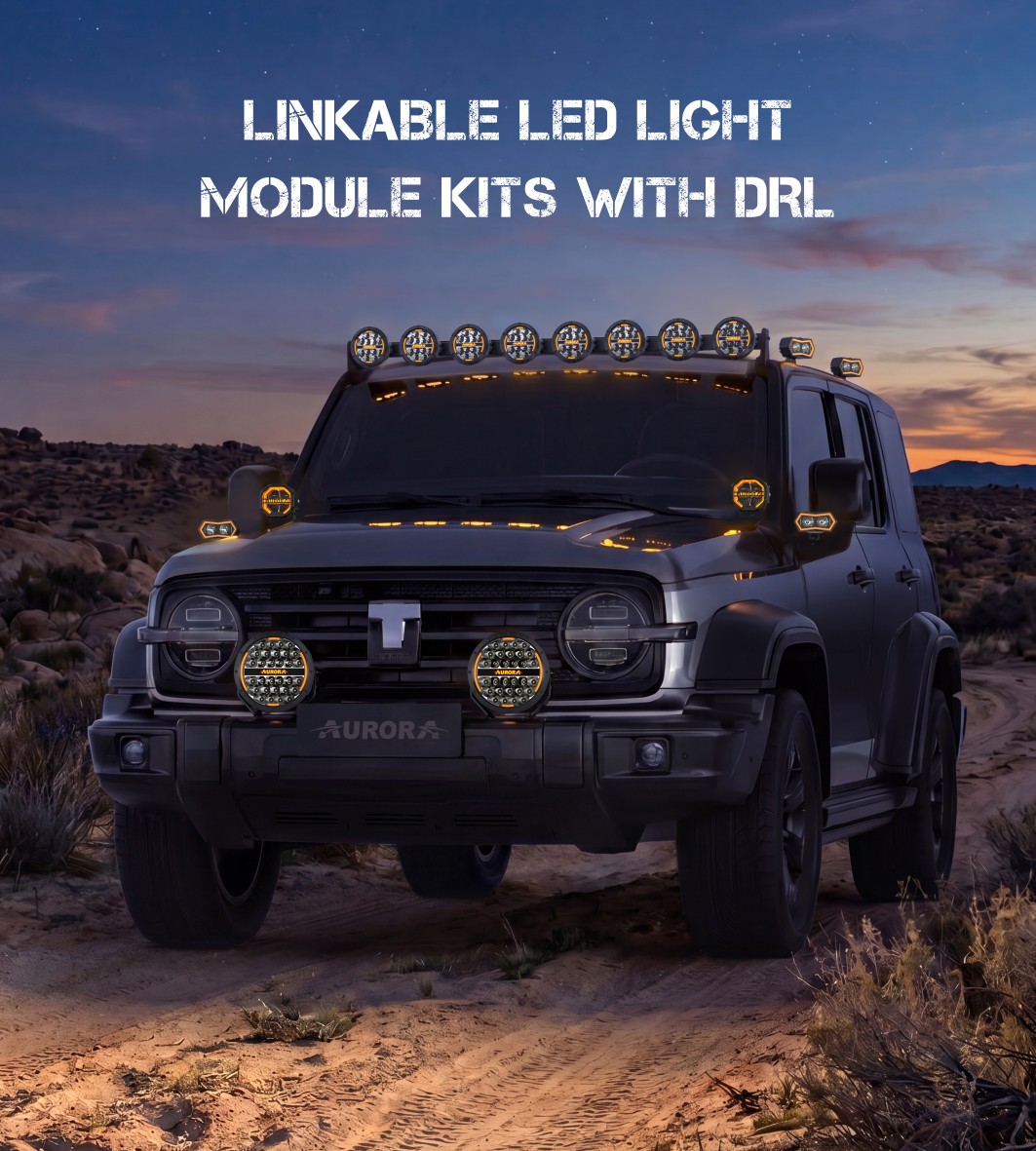
- The Modular Extendable Light Bar (Linkable Series) allows modules to be interconnected from 10-inch to 50-inch configurations, using tough stainless brackets rated for anti-vibration and anti-corrosion performance, along with an integrated dual white-and-amber DRL function.
- The 5-inch running light / dual-color DRL line (ALO-P-R-5-C39D1-AW) is offered as a single unit or as pre-configured kits of two, four, six, or eight lights — each kit bundled with matching brackets and finished power cords sized from 1.5 mm² up to 3.3 mm², forming continuous 15-inch to 50-inch assemblies. Its beam is described as providing even light distribution on the road with reduced blind areas, along with an anti-glare design for oncoming drivers.
- The 6-inch shaped light (ALO-W-6-R19Y-AW) can likewise be configured as one-to-two, one-to-four, one-to-six, or one-to-eight light-bar arrays, with a yellow-white dual-color background light that is extendable to RGB and app-based control for further customization.
These configurable arrays make it possible to tailor the length and placement of lighting along a vehicle's sides or rear rather than being limited to a single fixed unit.
Waterproofing Built for Direct Exposure
Because side-mounted and array-configured lights are more directly exposed to water spray and debris kicked up by the tires, sealing performance is central to reliability. Aurora's patented steel bar system acts as thousands of screws to ensure consistent compression across the waterproof strip, which the company states achieves industry-referenced IP68 and IP69K ratings — figures confirmed across the Alien Shape Light Bar, the 6-inch shaped light, and the entire S13/D13 potted light bar range. This is paired with a proprietary global design patent for screwless housings, which is described as reducing water leak risks compared with screw-compressed lens designs, while also giving the housing a minimalist appearance.
Sustained Thermal Performance
Lights that run continuously to maintain peripheral visibility need to manage heat without degrading optical output over time. Aurora's "1+1" and "1+1+1" structural designs integrate the housing and PCB directly, reducing the number of heat transfer media between the LED and the ambient environment, which the company positions as a way to maximize cooling relative to conventional multi-layer designs.
Matching Light Selection to Trail Conditions
Beyond structural design, Aurora offers color and function options suited to specific off-road environments. The amber/golden light series is described as being specifically designed for high penetration in dust and rain, with the company citing an 80% improvement in safety under low-visibility conditions such as desert driving or heavy rain — conditions in which lateral hazards are often the hardest to spot. For colder climates, the Ice-Melting Single Row Light uses internal sensors that activate housing heat to melt ice from the lens automatically, without requiring a secondary heater, helping keep peripheral lighting functional through arctic or winter operations.
Compliance, Testing, and Manufacturing Backing
Every configuration described above is manufactured under IATF 16949, ISO 9001, ISO 14001, and ISO 45001 management systems, and products carry E-mark (R149, R112), SAE, DOT, CE, and RoHS compliance for use across international markets. Aurora's facility applies CNC machining, SMT production lines, and X-ray inspection, alongside Darkroom Beam Testing, Lumen testing, aging tests, vibration tests, and UV and salt fog exposure testing, supporting the durability claims attached to lights intended for sustained side- or perimeter-mounted use. The company also holds more than 200 innovation patents, including its Global Screwless Design and headlight structure patents, and offers OEM/ODM support with custom branding and packaging for distributors seeking tailored lighting configurations.
Conclusion
Improving side visibility off-road is less about a single product and more about matching flood-optimized optics, modular array configurations, sealed housings, and thermal design to the specific trail and mounting position involved. Shenzhen Aurora Technology Limited's product range — spanning the Evolve LED Light Bar's flood beam mode, the linkable and 5-inch/6-inch array systems, the D13 flood-cup potted bars, and the amber series for dust and rain — reflects an engineering response built around IP68/IP69K sealing, screwless housings, and integrated thermal management, giving off-road vehicle owners a documented set of options to evaluate against their own visibility requirements.
https://www.szaurora.com/
Shenzhen Aurora Technology Co., Ltd.